


Introduction
Sourcing custom USB-C cables from China can help brands, wholesalers, and distributors develop products for specific markets. However, successful sourcing requires more than choosing a cable design and comparing prices. Buyers need clear technical specifications, suitable customization options, reliable samples, and a plan for repeat orders. This guide explains how to turn your requirements into a clear manufacturing order.
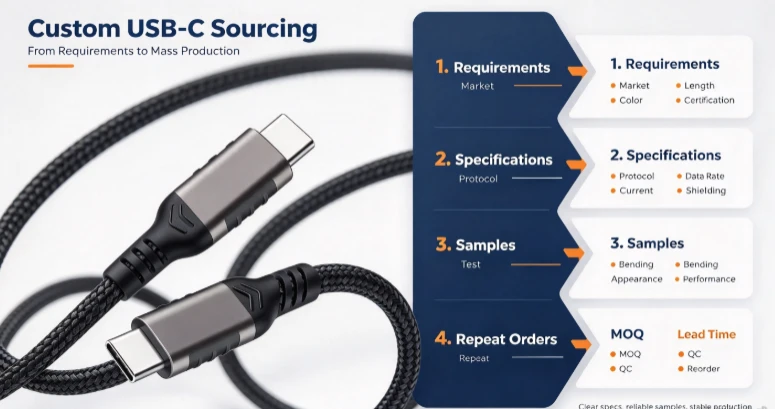
1. Define Your Product Requirements
Before contacting a custom USB-C cable manufacturer, decide how the cable will be used. A charging cable may have different requirements from one designed for fast data transfer or video output.
Prepare a specification sheet covering:
- Connector types and cable length
- Required charging power
- Data transfer speed
- Video support, if needed
- Cable material and color
- Packaging and branding
USB-C describes the connector type, not every feature a cable supports. The USB-IF cable resources explain why cable capabilities must match the intended application.
You can explore this USB-C cable product range to identify suitable product types before requesting a quotation.


2. Choose the Right Customization Options
Customization can involve more than adding a logo. Depending on the manufacturer's capabilities, buyers may request different cable lengths, connector housings, jacket materials, colors, labels, or retail packaging.
Decide which features are essential and which are optional. This helps control costs and prevents unnecessary design changes.
If you plan to sell products under your own brand, ask about OEM and ODM manufacturing services. Confirm available options, minimum order quantities (MOQ), sample costs, and any tooling fees before production begins.
3. Confirm Technical Specifications
Do not rely on descriptions such as "fast charging" or "high speed" alone. Ask the supplier to state the supported power rating, data rate, and other required features in writing.
For example, a cable intended for high-power charging may require different construction from a basic charging cable. Some applications may also require electronic marking or specific compliance testing.
Review the official USB Type-C cable and connector specification and confirm that the proposed product matches your requirements.
4. Approve Samples Before Bulk Production
A sample gives you a chance to check the product before placing a large order.
Test the cable with compatible devices and inspect connector fit, flexibility, finish, and overall construction. Check that the required charging, data, or video functions work as expected.
Record the approved specifications and keep a reference sample where practical. Any changes to materials, connectors, or design should be agreed upon before mass production.
5. Check Quality Control and Order Terms
Ask how the manufacturer checks materials, tests finished cables, and handles defective products. Request relevant test records and confirm whether they apply to the exact model you intend to order.
You can also review the supplier's quality control process to understand its stated approach to product inspection.
Before confirming the order, agree on the MOQ, unit price, packaging, lead time, payment terms, shipping arrangements, and defect-handling process. Clear written terms help reduce misunderstandings.
6. Plan for Repeat Orders
For wholesalers and distributors, the first order is only part of the sourcing process. Future batches should follow the same approved specifications unless changes are formally agreed upon.
Keep records of the product model, materials, packaging, test requirements, and approved sample. Discuss expected demand and production lead times with your supplier so future orders can be planned more effectively.
Conclusion
Sourcing custom USB-C cables from China starts with clear requirements and continues through specification checks, sample approval, quality control, and repeat-order planning. For B2B buyers, a well-documented process helps control costs, reduce production risks, and build a more reliable supply relationship.
FAQ
1. How do I source custom USB-C cables from China?
Define your requirements, contact suitable manufacturers, compare quotations, test samples, and confirm order terms in writing.
2. Can I customize USB-C cable length and color?
Yes, but availability and minimum quantities vary by design.
3. What information should I include in a quotation request?
Include connector types, length, power rating, data speed, video requirements, materials, quantity, and packaging needs.
4. Do all USB-C cables support fast charging?
No. Charging capability depends on the cable's design, power rating, and compatibility with the connected devices.
5. Can I order private-label USB-C cables?
Some manufacturers offer logo printing, custom packaging, and other branding options. Confirm costs and production requirements.
6. What affects the cost of custom USB-C cables?
Cable specifications, materials, length, order quantity, branding, packaging, testing, and shipping can all affect the final cost.